Skip to content

Forecasting

Venables Award

Alex Lee and I are the joint winners of the 2024 Venables Award for new developers of open source software for data analytics! My submission was pypfilt, my Python package that implements various particle filter methods. Alex Lee's submission was whereabouts, a Python package for bulk geocoding and address standardisation.

This award is judged by the Statistical Computing and Visualisation section of the Statistical Society of Australia, and sponsored by the Australian Research Data Commons. Later this year we'll both appear in the ARDC's Shaping Research Software article series, and showcase our software packages in an SSA seminar.

It's a thrilling surprise and genuine honour to win this award. I'm looking forward to sharing thoughts and reflections on pypfilt and research software engineering in general, and in hearing about Alex Lee's work.

My biggest hope is that other people will find pypfilt useful for their own work 🀞🏼

Info

Our ARDC interview was published in Feburary 2025.
No single-biggest roadblock

"It is difficult to make predictions, especially about the future" β€” this famous quote is a great opening line when discussing infectious disease forecasting. I used it in my talk at the Australian Influenza Symposium (1-2 Nov 2017), as did a speaker in an earlier session. And there are many reasons why infectious disease forecasting is hard. There isn't a single-biggest roadblock to making accurate epidemic forecasts, and I was recently quoted about this very matter in "How Bad Will the Flu Season Get? Forecasters Are Competing to Figure it Out" (The Scientist, 28 Nov 2017).

I really enjoy the challenge of engaging with non-academic audiences, both as an end in itself, and also because it should help me improve my grant writing. And this isn't my first experience with the media. I've previously been quoted in articles about the link between climate and influenza transmission (Flu outbreaks are subject to humidity β€” not just heat, Cosmos, 1 Nov 2016), and our collaboration with the Victorian Department of Health and Human Services (Defence scientists' bio attack detector could predict flu outbreaks, Herald Sun, 14 Jul 2016).

Epidemic forecasts as a tool for public health

Infectious disease forecasting has been a very active research area in the past few years, and these methods have the potential to provide valuable decision-support capabilities for public health staff. There are many challenges that must be surmounted before this can be realised, and one major gap in the literature is operational research in pilot, real-world applications. We report on exactly this kind of study in our most recent forecasting paper, "Epidemic forecasts as a tool for public health: interpretation and (re)calibration", which has just been made available online and will appear in an upcoming issue of the Australian and New Zealand Journal of Public Health.

Disease surveillance: no silver bullet

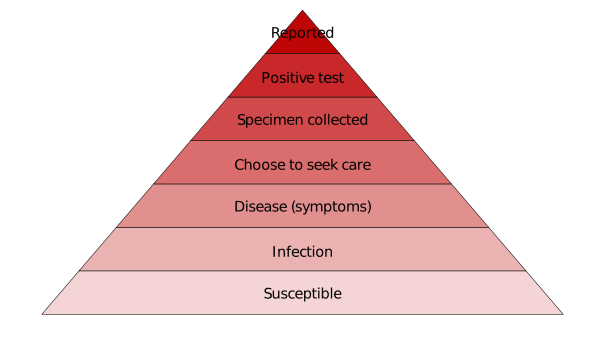
In thinking about the strengths and limitations of different surveillance systems β€” from the perspective of infectious disease forecasting in my case, but the point applies more generally β€” it becomes clear that there is no silver bullet. No one surveillance system will tell us everything we need to know in order to understand the current impact of a disease on a population, or to predict the future impact of a disease. The surveillance pyramid model illustrates this in a very nice and clear manner:

Surveillance pyramid

Figure 1: the (infectious disease) surveillance pyramid.

Model selection for seasonal influenza forecasting

Two firsts in one: "Model selection for seasonal influenza forecasting" is Alex's first first-author and my first last-author paper. It will appear in an upcoming issue of Infectious Disease Modelling, a new open access journal with a focus on the interface between mathematical modelling, data analysis, and public health decision support.

This paper presents a likelihood-based method for selecting models that best predict future data (when conditioned on past data), and uses it to evaluate the predictive skill of disease transmission models that incorporate various features, such as inhomogeneous population mixing and climatic effects on transmission. I won't say any more here; if you're interested, read the paper!

The source code used to generate all of the results presented in this manuscript is available under the BSD 3-Clause license.

A week is a long time in politics

A year has passed since my last post, and much has happened. I contributed to 6 government reports, submitted 5 first-author papers, became a reviewer for 4 more journals, gave 3 talks about our influenza forecasting project, enrolled 2 jurisdictions in our forecasting project, and joined 1 surveillance system. Here is the 2015/16 financial year recap …