Skip to content

2017

Disease surveillance: no silver bullet

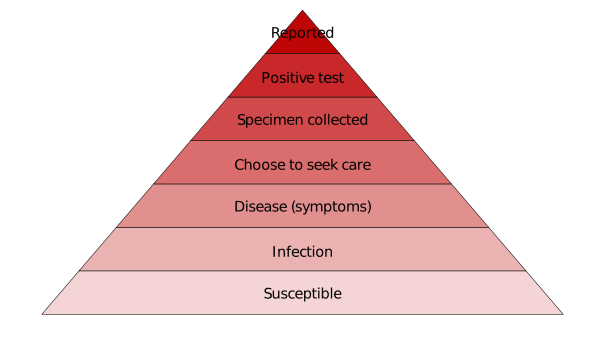
In thinking about the strengths and limitations of different surveillance systems — from the perspective of infectious disease forecasting in my case, but the point applies more generally — it becomes clear that there is no silver bullet. No one surveillance system will tell us everything we need to know in order to understand the current impact of a disease on a population, or to predict the future impact of a disease. The surveillance pyramid model illustrates this in a very nice and clear manner:
Surveillance pyramid

Figure 1: the (infectious disease) surveillance pyramid.

Compartmental models in Rust

I've been learning a bit of Rust in the past few weeks, mostly by writing some basic SIR-type models (both as ODE systems, and as continuous-time and discrete-time Markov chains). It takes most (maybe all) of the things that I like about OCaml and adds more great features and safety guarantees, thanks to its ownership model and lifetimes. It's also very fast (no garbage collector, zero-cost abstractions) and has fantastic tooling, although compilation times can be very long, and package ("crate") availability can be very hit-or-miss. I've enjoyed it enough that I'm looking forward to writing more Rust code in the future. Although I've no plans to rewrite pypfilt or epifx in Rust any time soon!

Model selection for seasonal influenza forecasting

Two firsts in one: "Model selection for seasonal influenza forecasting" is Alex's first first-author and my first last-author paper. It will appear in an upcoming issue of Infectious Disease Modelling, a new open access journal with a focus on the interface between mathematical modelling, data analysis, and public health decision support.

This paper presents a likelihood-based method for selecting models that best predict future data (when conditioned on past data), and uses it to evaluate the predictive skill of disease transmission models that incorporate various features, such as inhomogeneous population mixing and climatic effects on transmission. I won't say any more here; if you're interested, read the paper!

The source code used to generate all of the results presented in this manuscript is available under the BSD 3-Clause license.